


How One YouTube Video Review Took Down a $2.5 Billion Company
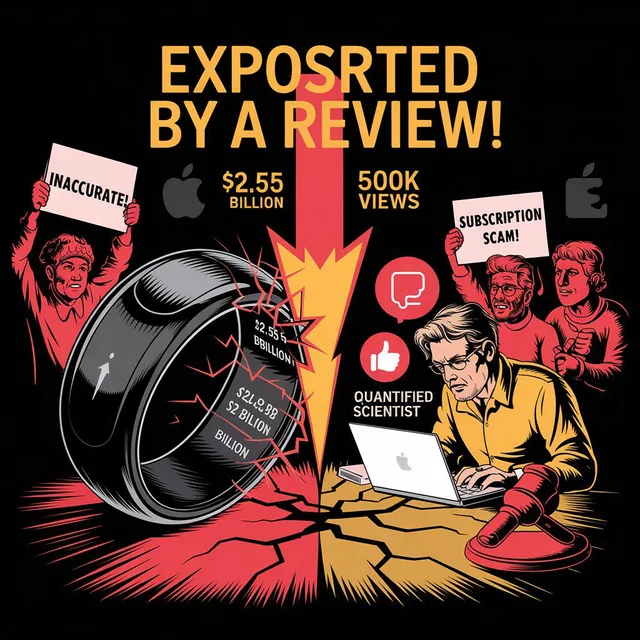
I’ve always been curious about how tech companies blow up—and sometimes crash just as fast. Recently, I got deep into the story of Oura, the Finnish company behind the Oura Ring (you know, that smart ring that tracks your sleep, heart rate, and daily activity).
At first, Oura looked like they had it all figured out. Then one YouTube video flipped everything upside down. Here’s what I found.
By 2022, Oura was killing it. They were worth $2.55 billion, had sold over a million rings, and had big-name fans like Kim Kardashian and Prince Harry. They raised $150 million, partnered with Best Buy and Gucci, and were even getting taken seriously by legit research institutions.
Everything was looking up—until November 2023.
That’s when a YouTuber called The Quantified Scientist dropped a review that hit hard.
This wasn’t just some random opinion either—he used medical-grade equipment to test the new Gen 3 Oura Ring.
The results? Not good:
-
Heart rate tracking was off by 20–30% during workouts.
-
Sleep tracking (the thing Oura is supposed to be best at) kept confusing being awake with being asleep.
-
The old Gen 2 model was actually more accurate than the fancy new one.
Keep in mind, the Gen 3 cost $300 plus a $5.99 monthly subscription. So people were paying more—for worse results.
The video blew up, pulling in over half a million views. Pretty soon, users all over the internet started sharing their own horror stories.
A lot of people were already pissed about the whole subscription thing, but now it wasn’t just about money—it was about trust.
By 2024, you could see the damage:
-
Oura’s value dropped to around $2 billion.
-
They had to lay off about 100 employees.
-
They rushed out a software update to "fix" the Gen 3... but it barely made a difference.
-
Then came a class-action lawsuit in the U.S. accusing them of false advertising.
And while all that was happening, Samsung dropped their own smart ring—with no subscription fees—making Oura look even worse.
Other big names like Apple and Fitbit were already better at tracking health stuff anyway.
What’s crazy is that it all started with one honest, data-backed YouTube review.
One video exposed a billion-dollar company.
It’s a huge reminder that today, if you sell hype over real results, it can all fall apart—fast.
Categorie
Leggi tutto
As Diablo IV continues to evolve, Blizzard’s ongoing class expansions are steadily reshaping how players approach combat, survivability, and diablo 4 gear. Among all the newly introduced elements, few have generated as much excitement as the arrival of the Paladin—a class that blends overwhelming defense with surprisingly passive offensive power. What makes this iteration of the...

Group health insurance is a health coverage plan designed for a defined group, typically employees of a company, and issued under one insurance policy. It delivers extensive medical benefits at lower costs compared to individual plans, often covering hospitalization, maternity care, and preventive healthcare services. Group Health Insurance Market Size, Share The group health insurance...

Diana Taurasi scored her 1, 000th vocation a few-pointer in just the WNBA period idea-off upon Friday evening in just unbelievably Diana Taurasi type. 1 of the league residing legends and least complicated trash-talkers inside of experienced basketball, Taurasi screamed motherf following attaining a mark no participant inside the W includes at any time significant supporter of any participant...

You don’t really understand Act 2 until Balbala floors you once. I walked in feeling fine, pockets light on PoE 2 Currency and heavy on confidence, and that lasted about ten seconds. This fight isn’t a pure DPS check. It’s a stress test: can your build move, recover, and stay readable when the room itself is trying to trip you up. The Arena Is the First Enemy That tiny chamber...

In today's fast-paced world, staying alert and focused can be a challenge—especially for those working night shifts, managing multiple jobs, or struggling with sleep disorders. Waklert 150 mg has gained popularity as a powerful solution to boost wakefulness and mental performance. But what exactly is Waklert, and how does it work? What is Waklert 150 mg? Waklert 150 mg is a brand-name...
